![]() |
“Difficult to Adapt People” – Roma and “Our” Victims in Post-Communist Memorial Museums
|
![]() |
Verlag der Österreichischen Akademie der Wissenschaften Austrian Academy of Sciences Press
A-1011 Wien, Dr. Ignaz Seipel-Platz 2
Tel. +43-1-515 81/DW 3420, Fax +43-1-515 81/DW 3400 https://verlag.oeaw.ac.at, e-mail: verlag@oeaw.ac.at |
|
||||||||||||||||||||
|
DATUM, UNTERSCHRIFT / DATE, SIGNATURE
BANK AUSTRIA CREDITANSTALT, WIEN (IBAN AT04 1100 0006 2280 0100, BIC BKAUATWW), DEUTSCHE BANK MÜNCHEN (IBAN DE16 7007 0024 0238 8270 00, BIC DEUTDEDBMUC)
|

IKT publications8, pp. , 2022/03/22
Ljiljana Radonić
"Difficult to adapt people" – Roma and "our" victims in postcommunist memorial museums
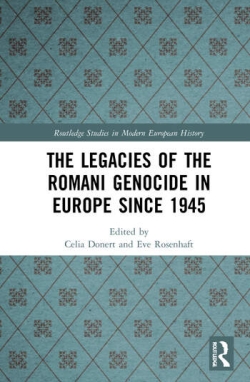
In: Celia Donert/Eve Rosenhaft (Ed.): The Legacies of the Romani Genocide in Europe since 1945, Routledge 2022
First published 02/2022
https://www.routledge.com/The-Legacies-of-the-Romani-Genocide-in-Europe-since-1945/Donert-Rosenhaft/p/book/9780367275587
This article is a result of my larger five-year (habilitation) project on publicly funded post-communist memorial museums that focus primarily on the Second World War period. I analyzed how such institutions in all present-day “Eastern” EU member states changed their permanent exhibitions and museum guidebooks1F2 over time, especially in the course of EU accession talks. In this paper I explore how Roma have been, if at all, represented in permanent exhibitions in these memorial museums. How have the “universalization of the Holocaust” and the “Europeanization of the Roma genocide” influenced the memory of the Roma genocide in post-communist countries in the course of EU integration? Which role do Roma play in what I came to call the “hierarchy of visibility” of different victim groups represented at the museums?
Project
This project has received funding from the European Research Council (ERC) under the European Union’s Horizon 2020 research and innovation program (GMM - grant agreement No. 816784).