• Institute of Culture Studies and Theatre History

The politics of commemoration and memorialization

Bild


Ljiljana Radonić
The politics of commemoration and memorialization
in: Maria Mälksoo (Ed.): Handbook on the Politics of Memory, Edward Elgar Publishing Limited, 2023. ProQuest Ebook Central, pp. 130-146.

Published online: 08/2024

http://ebookcentral.proquest.com/lib/univie/detail.action?docID=7242998

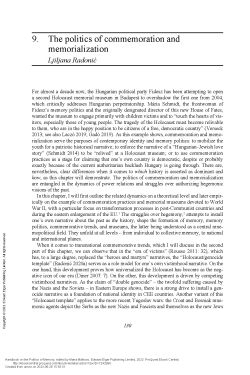
Who chooses to deal with which historical event how and when is all about today’s identity purposes. Thus, commemoration and memorialization are always politicized, always a manipulation of history. And yet we tend to idealize bottom-up grassroot processes while being skeptical towards official memory politics. Instead, I argue that two benchmarks make the most difference. Firstly, are memory on the one hand and scholarship in general and historiography in particular on the other hand building upon each other or is debate fueled by arguments disproven by the state of research? And secondly, are the mnemopolitical agents involved acting as “mnemonic pluralists” for whom it is understood that different groups have different memories that need to have a space in the society. Or are they “mnemonic warriors” who enforce their history as the history – even with undemocratic means? In the “era of victims”, which have to a large degree replaced heroes and martyrs narratives, the Holocaust and genocide template serves as a role model for one’s own victimhood narrative. On the one hand this proves how universalized the Holocaust has become as the negative icon of our era. On the other hand, this development is driven by competing victimhood narratives. When it comes to international memorial days, this means that in “addition” to the Holocaust Memorial Day the European Day of Remembrance for Victims of Stalinism and Nazism became part of the European commemoration canon after the Eastern Enlargement of the EU and thus of the “Europeanization of Memory”. Yet, while the Holocaust Memorial Day is all about “negative memory” of crimes committed, not suffered by the respective majority population, the remembrance of totalitarianism externalizes responsibility to Hitler and Stalin and focuses one one’s own victimhood. As this “double genocide” – suffered by the Nazis and the Soviets – in Eastern Europa shows, everyone wants to have their own genocide. Another variant of this Holocaust template applies to the more recent Yugoslav wars: Croat and Bosniak mnemonic warriors depict Serbs as the new Nazis and Fascists and themselves as the new Jews in the wars of the 1990s. Serbs on the other hand justified their crimes in the 1990s as prevention of a new Holocaust against them and the Jews. Another mnemopolitical field are public memorial museums – flagships of national identity. They of course differ strongly along several lines: Were they initiated by mnemonic pluralists or warriors? Are they supposed to mobilize a nationalist domestic audience or are they meant as an international signal to prove the respective countries place in the international community? I argue that during the Eastern Enlargement of the EU, one group of public memorial museums were designed in order to prove their county’s Europe-readiness. Another group of museums respectively the governments and other mnemopolitical agents who used them as their mnemopolitical tools argued that Europe and the West must acknowledge their country’s suffering under Stalinism. Both groups of museums referred to Holocaust memorial museums as their role model – yet sometimes copying their aesthetics in order to transport the completely opposite message. Finally, the chapter discusses – on the example of memorial museums – what happens when mnemonic warriors are in government, start abolishing democratic rights, checks and balances and remodeling the memorialization and museum landscape.

Project

This project has received funding from the European Research Council (ERC) under the European Union’s Horizon 2020 research and innovation program (GMM - grant agreement No. 816784).

Verlag der Österreichischen Akademie der Wissenschaften
Austrian Academy of Sciences Press
A-1011 Wien, Dr. Ignaz Seipel-Platz 2
Tel. +43-1-515 81/DW 3420, Fax +43-1-515 81/DW 3400
https://verlag.oeaw.ac.at, e-mail: verlag@oeaw.ac.at

Bestellung/Order


Bild
The politics of commemoration and memorialization


Send or fax to your local bookseller or to:

Verlag der Österreichischen Akademie der Wissenschaften
Austrian Academy of Sciences Press
A-1011 Wien, Dr. Ignaz Seipel-Platz 2,
Tel. +43-1-515 81/DW 3420, Fax +43-1-515 81/DW 3400
https://verlag.oeaw.ac.at, e-mail: bestellung.verlag@oeaw.ac.at
UID-Nr.: ATU 16251605, FN 71839x Handelsgericht Wien, DVR: 0096385

Bitte senden Sie mir
Please send me
 
Exemplar(e) der genannten Publikation
copy(ies) of the publication overleaf


NAME


ADRESSE / ADDRESS


ORT / CITY


LAND / COUNTRY


ZAHLUNGSMETHODE / METHOD OF PAYMENT
    Visa     Euro / Master     American Express


NUMMER

Ablaufdatum / Expiry date:  

    I will send a cheque           Vorausrechnung / Send me a proforma invoice
 
DATUM, UNTERSCHRIFT / DATE, SIGNATURE

BANK AUSTRIA CREDITANSTALT, WIEN (IBAN AT04 1100 0006 2280 0100, BIC BKAUATWW), DEUTSCHE BANK MÜNCHEN (IBAN DE16 7007 0024 0238 8270 00, BIC DEUTDEDBMUC)
Bild

The politics of commemoration and memorialization

    Ljiljana Radonić

IKT publications33, pp. , 2024/08/08


PDF
X
BibTEX-Export:

X
EndNote/Zotero-Export:

X
RIS-Export:

X 
Researchgate-Export (COinS)

Permanent QR-Code

Ljiljana Radonić
The politics of commemoration and memorialization
in: Maria Mälksoo (Ed.): Handbook on the Politics of Memory, Edward Elgar Publishing Limited, 2023. ProQuest Ebook Central, pp. 130-146.

Published online: 08/2024

http://ebookcentral.proquest.com/lib/univie/detail.action?docID=7242998

Who chooses to deal with which historical event how and when is all about today’s identity purposes. Thus, commemoration and memorialization are always politicized, always a manipulation of history. And yet we tend to idealize bottom-up grassroot processes while being skeptical towards official memory politics. Instead, I argue that two benchmarks make the most difference. Firstly, are memory on the one hand and scholarship in general and historiography in particular on the other hand building upon each other or is debate fueled by arguments disproven by the state of research? And secondly, are the mnemopolitical agents involved acting as “mnemonic pluralists” for whom it is understood that different groups have different memories that need to have a space in the society. Or are they “mnemonic warriors” who enforce their history as the history – even with undemocratic means? In the “era of victims”, which have to a large degree replaced heroes and martyrs narratives, the Holocaust and genocide template serves as a role model for one’s own victimhood narrative. On the one hand this proves how universalized the Holocaust has become as the negative icon of our era. On the other hand, this development is driven by competing victimhood narratives. When it comes to international memorial days, this means that in “addition” to the Holocaust Memorial Day the European Day of Remembrance for Victims of Stalinism and Nazism became part of the European commemoration canon after the Eastern Enlargement of the EU and thus of the “Europeanization of Memory”. Yet, while the Holocaust Memorial Day is all about “negative memory” of crimes committed, not suffered by the respective majority population, the remembrance of totalitarianism externalizes responsibility to Hitler and Stalin and focuses one one’s own victimhood. As this “double genocide” – suffered by the Nazis and the Soviets – in Eastern Europa shows, everyone wants to have their own genocide. Another variant of this Holocaust template applies to the more recent Yugoslav wars: Croat and Bosniak mnemonic warriors depict Serbs as the new Nazis and Fascists and themselves as the new Jews in the wars of the 1990s. Serbs on the other hand justified their crimes in the 1990s as prevention of a new Holocaust against them and the Jews. Another mnemopolitical field are public memorial museums – flagships of national identity. They of course differ strongly along several lines: Were they initiated by mnemonic pluralists or warriors? Are they supposed to mobilize a nationalist domestic audience or are they meant as an international signal to prove the respective countries place in the international community? I argue that during the Eastern Enlargement of the EU, one group of public memorial museums were designed in order to prove their county’s Europe-readiness. Another group of museums respectively the governments and other mnemopolitical agents who used them as their mnemopolitical tools argued that Europe and the West must acknowledge their country’s suffering under Stalinism. Both groups of museums referred to Holocaust memorial museums as their role model – yet sometimes copying their aesthetics in order to transport the completely opposite message. Finally, the chapter discusses – on the example of memorial museums – what happens when mnemonic warriors are in government, start abolishing democratic rights, checks and balances and remodeling the memorialization and museum landscape.

Project

This project has received funding from the European Research Council (ERC) under the European Union’s Horizon 2020 research and innovation program (GMM - grant agreement No. 816784).