• ACDH - Austrian Centre for Digital Humanities

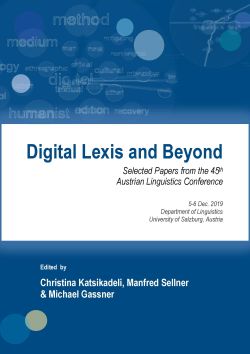
Digital Lexis, and Beyond

Selected Papers from the Workshop „Digital Lexis, and Beyond”
45th Austrian Linguistics Conference
Dec. 2019

Bild


This volume of proceedings contains selected papers from the workshop “Digital Lexis, and Beyond” that was held as part of the “45th Austrian Linguistics Conference” in December 2019. The individual papers collected in this volume cover a rather big range of diverse topics within the limits set by the suggested topical bounds of “lexis”. The contributions discuss and investigate digital “tools” and “methods” and show different foci of attention: the documentation of language usage in Greek, Aramaic, Arabic, Austrian German Dialects, and their possibilities of digital access, as well as the exploration of linguistic phenomena, such as diachronic change, the appearance of new linguistic varieties, or the detection of sentiments in literature. All the papers have been peer reviewed (according to a double-blind peer review procedure) by specialists in their respective fields, so that the editors are confident of their academic quality and usefulness for future research in “digital lexicography” and “corpus linguistics”.

epub.oeaw – Institutionelles Repositorium der Österreichischen Akademie der Wissenschaften
epub.oeaw – Institutional Repository of the Austrian Academy of Sciences
A-1011 Wien, Dr. Ignaz Seipel-Platz 2
Tel. +43-1-515 81/DW 3420, Fax +43-1-515 81/DW 3400
http://epub.oeaw.ac.at, e-mail: epub@oeaw.ac.at

Bestellung/Order


Bild
Digital Lexis, and Beyond


ISBN 978-3-7001-8916-9
Online Edition


Send or fax to your local bookseller or to:

Verlag der Österreichischen Akademie der Wissenschaften
Austrian Academy of Sciences Press
A-1011 Wien, Dr. Ignaz Seipel-Platz 2,
Tel. +43-1-515 81/DW 3420, Fax +43-1-515 81/DW 3400
https://verlag.oeaw.ac.at, e-mail: bestellung.verlag@oeaw.ac.at
UID-Nr.: ATU 16251605, FN 71839x Handelsgericht Wien, DVR: 0096385

Bitte senden Sie mir
Please send me
 
Exemplar(e) der genannten Publikation
copy(ies) of the publication overleaf


NAME


ADRESSE / ADDRESS


ORT / CITY


LAND / COUNTRY


ZAHLUNGSMETHODE / METHOD OF PAYMENT
    Visa     Euro / Master     American Express


NUMMER

Ablaufdatum / Expiry date:  

    I will send a cheque           Vorausrechnung / Send me a proforma invoice
 
DATUM, UNTERSCHRIFT / DATE, SIGNATURE

BANK AUSTRIA CREDITANSTALT, WIEN (IBAN AT04 1100 0006 2280 0100, BIC BKAUATWW), DEUTSCHE BANK MÜNCHEN (IBAN DE16 7007 0024 0238 8270 00, BIC DEUTDEDBMUC)
Bild

(Dis)continuities in the diachrony of the Greek lexicon: The learned component in the light of a corpus analysis

    Asimakis Fliatouras, Konstantinos Sampanis

Digital Lexis, and Beyond, pp. 1-20, 2021/04/21

Selected Papers from the Workshop „Digital Lexis, and Beyond”
45th Austrian Linguistics Conference
Dec. 2019

doi: 10.1553/Greek_Lexicons1

doi: 10.1553/Greek_Lexicon


PDF
X
BibTEX-Export:

X
EndNote/Zotero-Export:

X
RIS-Export:

X 
Researchgate-Export (COinS)

Permanent QR-Code

doi:10.1553/Greek_Lexicons1


doi:10.1553/Greek_Lexicon

Abstract

A most notable feature of Standard Modern Greek (SMG) lexicon is the abundance of pairs of lexemes of similar meaning which belong to different registers. Thus, while one lexeme pertains to the colloquial language and is widely used both in oral and written speech, a semantically akin or even synonymous word of Ancient (i.e., Classical) Greek (AG) origin is also attested in specific contexts. The latter ones are usually described as part of the “archaic” or “learned” component of the Modern Greek (MG) lexicon. In the light of three case studies, our paper aims at investigating this variation by conducting research through diachronic corpora. We intend to disperse certain misconceptions concerning lexical change (which is erroneously interpreted as a straightforward replacement of an “older” word with a new one) and to introduce the concepts of adstratal and superstratal lexicon along with the theory of prototypicality and exaptation in the relevant research. Along with dealing with the diachrony of the Greek lexicon, our account sketches a first theoretical framework for investigating the lexicon of languages with a long-recorded history and diglossic contradictions. Accordingly, it emphasizes the vital role of corpora research in diachronic semantics and onomasiology

Keywords: semantic change, onomasiological change, diachronic lexicon, Greek