• ACDH - Austrian Centre for Digital Humanities

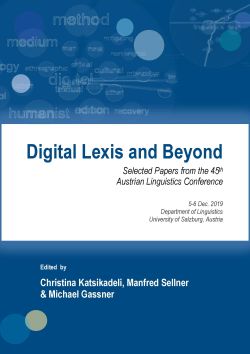
Digital Lexis, and Beyond

Selected Papers from the Workshop „Digital Lexis, and Beyond”
45th Austrian Linguistics Conference
Dec. 2019

Bild


This volume of proceedings contains selected papers from the workshop “Digital Lexis, and Beyond” that was held as part of the “45th Austrian Linguistics Conference” in December 2019. The individual papers collected in this volume cover a rather big range of diverse topics within the limits set by the suggested topical bounds of “lexis”. The contributions discuss and investigate digital “tools” and “methods” and show different foci of attention: the documentation of language usage in Greek, Aramaic, Arabic, Austrian German Dialects, and their possibilities of digital access, as well as the exploration of linguistic phenomena, such as diachronic change, the appearance of new linguistic varieties, or the detection of sentiments in literature. All the papers have been peer reviewed (according to a double-blind peer review procedure) by specialists in their respective fields, so that the editors are confident of their academic quality and usefulness for future research in “digital lexicography” and “corpus linguistics”.

epub.oeaw – Institutionelles Repositorium der Österreichischen Akademie der Wissenschaften
epub.oeaw – Institutional Repository of the Austrian Academy of Sciences
A-1011 Wien, Dr. Ignaz Seipel-Platz 2
Tel. +43-1-515 81/DW 3420, Fax +43-1-515 81/DW 3400
http://epub.oeaw.ac.at, e-mail: epub@oeaw.ac.at

Bestellung/Order


Bild
Digital Lexis, and Beyond


ISBN 978-3-7001-8916-9
Online Edition


Send or fax to your local bookseller or to:

Verlag der Österreichischen Akademie der Wissenschaften
Austrian Academy of Sciences Press
A-1011 Wien, Dr. Ignaz Seipel-Platz 2,
Tel. +43-1-515 81/DW 3420, Fax +43-1-515 81/DW 3400
https://verlag.oeaw.ac.at, e-mail: bestellung.verlag@oeaw.ac.at
UID-Nr.: ATU 16251605, FN 71839x Handelsgericht Wien, DVR: 0096385

Bitte senden Sie mir
Please send me
 
Exemplar(e) der genannten Publikation
copy(ies) of the publication overleaf


NAME


ADRESSE / ADDRESS


ORT / CITY


LAND / COUNTRY


ZAHLUNGSMETHODE / METHOD OF PAYMENT
    Visa     Euro / Master     American Express


NUMMER

Ablaufdatum / Expiry date:  

    I will send a cheque           Vorausrechnung / Send me a proforma invoice
 
DATUM, UNTERSCHRIFT / DATE, SIGNATURE

BANK AUSTRIA CREDITANSTALT, WIEN (IBAN AT04 1100 0006 2280 0100, BIC BKAUATWW), DEUTSCHE BANK MÜNCHEN (IBAN DE16 7007 0024 0238 8270 00, BIC DEUTDEDBMUC)
Bild

Investigating the linguistic representativeness of Early Modern Greek Corpora

    Eleni Karantzola, Yannis Kostopoulos, Konstantinos Sampanis

Digital Lexis, and Beyond, pp. 1-18, 2021/04/21

Selected Papers from the Workshop „Digital Lexis, and Beyond”
45th Austrian Linguistics Conference
Dec. 2019

doi: 10.1553/EModern_Greeks1

doi: 10.1553/EModern_Greek


PDF
X
BibTEX-Export:

X
EndNote/Zotero-Export:

X
RIS-Export:

X 
Researchgate-Export (COinS)

Permanent QR-Code

doi:10.1553/EModern_Greeks1


doi:10.1553/EModern_Greek

Abstract

Following a poorly documented period in the history of vernacular Greek (6th-12th c.), the late 15th century sets the beginning of a linguistic era characterized by a quantitatively and qualitatively incomparable production of prose texts written in “common” language. It is at this point that classicizing Greek stops dominating in writing, and a new linguistic variety – albeit a very diverse and fluid one – Early Modern Greek (EMG) starts growing rapidly as a literacy language. The development of this new variety is manifested in its widespread use as literary language (in texts with aesthetic function), as well as in its use as a simple scripta, namely a written vernacular for legal, administrative, commercial, and other functions. Despite its significance in the history of Greek, this period remains to a large extent unexplored and underrepresented in Greek language corpora. On this view, our understanding of EMG depends crucially on the representativeness of the few available corpora. The aim of this paper is to investigate the linguistic representativeness of EMG corpora, and to explore possible associations between observed linguistic patterns and corpora design. Focusing on the distribution of contrastive and reformulation markers, our study reveals that the linguistic data illustrated in the available EMG corpora are divergent and largely dependent on the representation of variables, such as text form (poetry/prose), period, geographical region, and genre

Keywords: Early Modern Greek, corpora representativeness, contrastive markers, reformulation markers