Project Repository “AFRICANON”
|
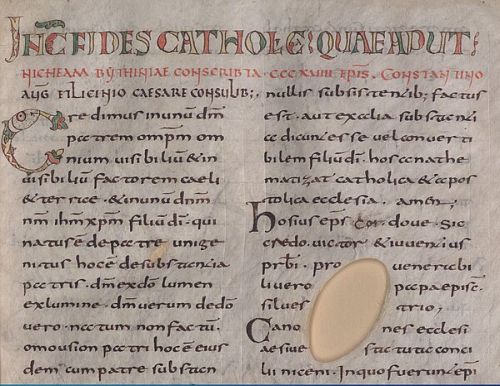
Codex München, Bayerische Staatsbibliothek CLM 6243, fol. 13r ("Collectio Frisingensis"), containing a partial transmission of the CCAR. The church of late antique North Africa exerted a lasting influence on the subsequent development of canon law in the Latin Middle Ages. Even though, from a European perspective, Northern Africa came to be regarded as a somewhat peripheral region at the latest after the Islamic conquest, this did not diminish the enduring significance attributed to the achievements of Late Roman Africa. Medieval scholars held Africa in high esteem not only for its theological writings – one need only think of Augustine, Cyprian, and of Tertullian – but also for its considerable contribution to canon law. The canons issued by synods of African bishops were considered authoritative texts and were widely received in medieval canonical collections. Already in term of quantity, their impact is remarkable: in the database “Clavis canonum – Selected Canon Law Collections”, which catalogues canon law collections from the sixth to the thirteenth century, 162 pre-Gratian collections are currently recorded. Of these, no fewer than 115 cite conciliar canons originating in late antique North Africa. These conciliar decrees address a wide range of subjects – by no means limited to what we would today call “ecclesiastical” matters: including the discipline of clergy and laity, marriage, slavery, liturgy, clerical ordination, criminal law, procedural law, the cult of saints, and the treatment of heretics. Since no original manuscripts of canonical texts from Late Roman North Africa have survived, our reconstruction of these regulations depends entirely on the aforementioned collections, most of which were written centuries after the texts they preserve. Virtually all extant manuscripts transmitting African conciliar canons date from after the eighth century, and none of them were produced in Africa itself. Thus, there exists a considerable chronological and geographical distance between the original acts and their transmitters – a gap so wide that one can scarcely speak of transmission in the strict sense, but rather of reception. This situation raises a series of questions: Why were these ecclesiastical texts so widely received in the first place? Has the legitimacy and authenticity of the African canons been contested or doubted in later periods? What role did Africa play in the “imagined landscape” of Western Christianity and Latin canon law? Were substantive alterations made to the African conciliar decrees in the course of their reception? How, in detail, did the process of transmission unfold? What was the “path” by which these African legal texts reached the medieval world? In other words: which later collections drew upon which earlier ones? A central issue in this context concerns a canon law collection known as the Corpus canonum Africano-Romanum, which partly consists of African legal texts. Its origins remain a matter of vigorous scholarly debate: while there is consensus regarding the great importance of this collection, which arose already in Late Antiquity, its place, date, and purpose of composition continue to be disputed. Moreover, there has so far been no comprehensive study of the Corpus canonum Africano-Romanum that analyzes all extant textual witnesses and, on that basis, attempts to propose a coherent solution. The goal of the MSCA project AFRICANON was precisely to fill this gap. The project results will be made available on this repository, please do not forget to check for continuous updates. All publications stored in this repository have been published open access and bear a unique and permanent persistent identifier (DOI) attributed either by the publishers or in the course of uploading to this repository. For research and education purposes, use of all publications found in this repository is unrestricted and free, but any commercial use without prior permission will be subject to legal prosecution. For questions regarding copyright and reuse, please contact us by email For more information about Africanon - The African Origins of Western Canon Law please visit the project homepage. Till Stüber Principal Investigator |
